India’s e-commerce market offers sellers several opportunities to reach customers online. Among the most popular marketplaces are Amazon, Flipkart, and Meesho. While all three platforms help businesses sell products online, they differ in terms of target customers, seller requirements, fees, product categories, competition, and onboarding processes.
Understanding the key differences between Amazon vs Flipkart vs Meesho can help sellers choose the right marketplace for their business and develop a successful online selling strategy.
Amazon vs Flipkart vs Meesho: An Overview
Amazon is a well-established global marketplace with a broad customer base and product selection. Flipkart is one of India’s leading homegrown e-commerce platforms with strong reach across multiple product categories. Meesho has gained popularity by focusing heavily on value-conscious customers, social commerce, and small businesses.
Each marketplace has its own advantages, making the right choice dependent on your products, target audience, pricing strategy, and business goals.
1. Target Customers
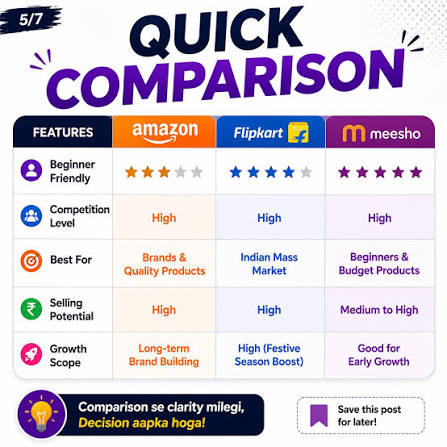
Amazon serves a wide range of customers and is particularly strong across electronics, home products, fashion, books, appliances, and everyday essentials.
Flipkart also has a broad customer base and is especially popular across categories such as electronics, mobile phones, fashion, appliances, and lifestyle products.
Meesho is widely known for affordable products and has become an important platform for small sellers, manufacturers, resellers, and businesses targeting price-sensitive customers.
2. Seller Onboarding
Seller onboarding is an important consideration when comparing Amazon, Flipkart, and Meesho.
Generally, sellers need to provide business information, bank details, tax-related information where applicable, and product details. The exact requirements can vary depending on the seller, product category, and marketplace policies.
A well-prepared seller account can make the onboarding process smoother and help sellers start listing products more efficiently.
3. Fees and Pricing
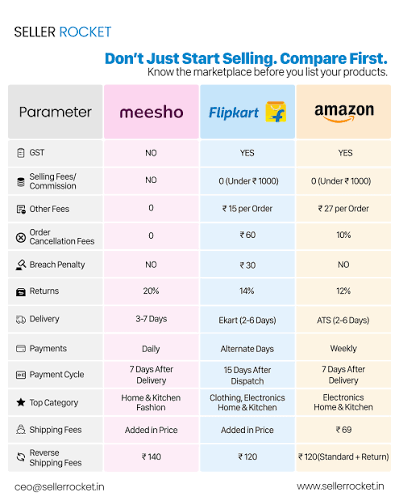
Marketplace fees can vary based on factors such as product category, selling price, fulfillment method, shipping, and applicable marketplace charges.
Amazon, Flipkart, and Meesho have different fee structures and seller programs. Therefore, sellers should review the current fee structure for their specific category instead of choosing a marketplace based only on general fee comparisons.
Profitability should be calculated by considering the selling price, marketplace fees, shipping costs, discounts, returns, and other operational expenses.
4. Product Categories
Amazon and Flipkart support a wide variety of product categories, making them suitable for businesses with diverse product catalogs.
Meesho has a strong presence in categories such as fashion, accessories, beauty, home products, and other affordable consumer goods.
Before registering, sellers should check whether their products meet the marketplace’s category requirements and selling policies.
5. Competition and Visibility
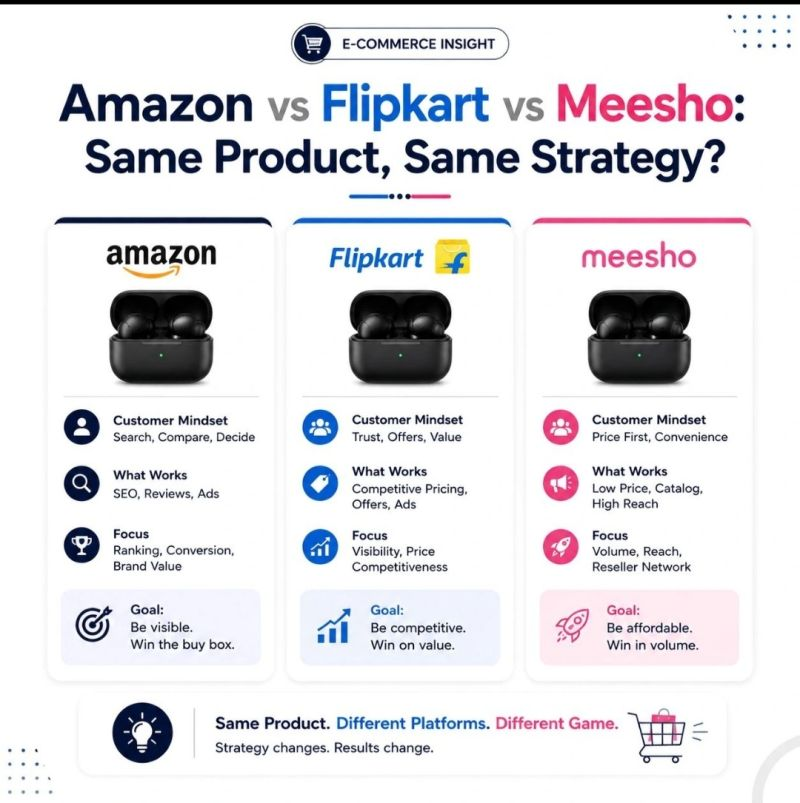
Competition is another major difference between these marketplaces. Popular categories can have many sellers competing for customer attention.
Successful sellers should focus on high-quality product images, optimized product titles, accurate descriptions, competitive pricing, positive reviews, and reliable fulfillment.
Which Marketplace Should Sellers Choose?
There is no single marketplace that is best for every business.
Amazon may be suitable for sellers looking for broad customer reach and a large product ecosystem. Flipkart can be attractive for businesses targeting India’s large online shopping audience. Meesho can be particularly relevant for sellers offering affordable products and targeting value-conscious customers.
Many businesses can also benefit from selling on multiple marketplaces rather than depending on a single platform.
Conclusion
The comparison of Amazon vs Flipkart vs Meesho shows that each marketplace offers different opportunities for online sellers. The best choice depends on your product category, target customers, pricing strategy, operational capabilities, and growth objectives.